Armand Lanusse (1812-1867) and the Poets of Les Cenelles
Armand Lanusse was born in New Orleans in 1812. Historians disagree on the question of whether or not he was, like many young free men of color of his generation, sent to Paris to be educated in the finest institutions. Whatever the circumstances of his education, Lanusse was at an early age already distinguishing himself from his peers with his impassioned dedication to the cause of all people of African descent, whom he considered to be his own people, without drawing distinctions in skin shades. Lanusse's poetry resembles that of the other contributors to Les Cenelles in its idolization of French romanticism in general and of Alphonse de Lamartine's Méditations Poétiques in particular. Lanusse’s work comments on the plight of people of color in New Orleans. The poets who wrote for Les Cenelles tended to draw exclusively on commonplace romantic themes of melancholy and fantasy, individualism and the mal du siècle, while remaining silent about the political implications of their racial status. But in his poetry Lanusse alludes to highly charged issues like the institution of plaçage (see “Épigramme†)--the arranged extra-marital unions between young free women of color and wealthy white men. As he wrote in the introduction to Les Cenelles, Lanusse was convinced that education was the only way that people of color might hope to improve their situation in life:
We are beginning to understand that no matter what situation fate has placed us in, a good education is a shield against the hostile, malicious arrows shot at us.
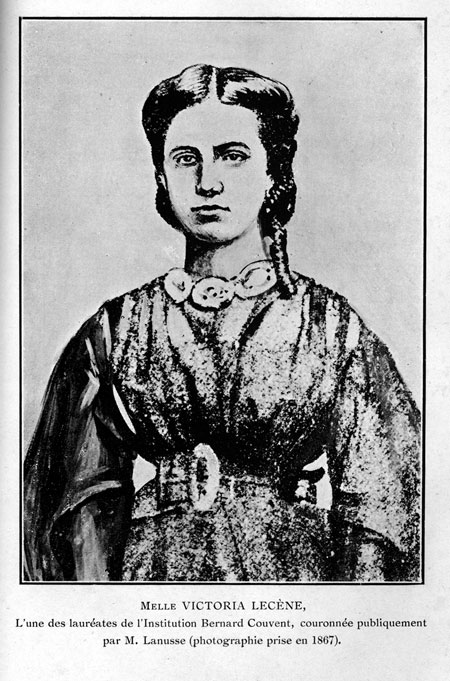
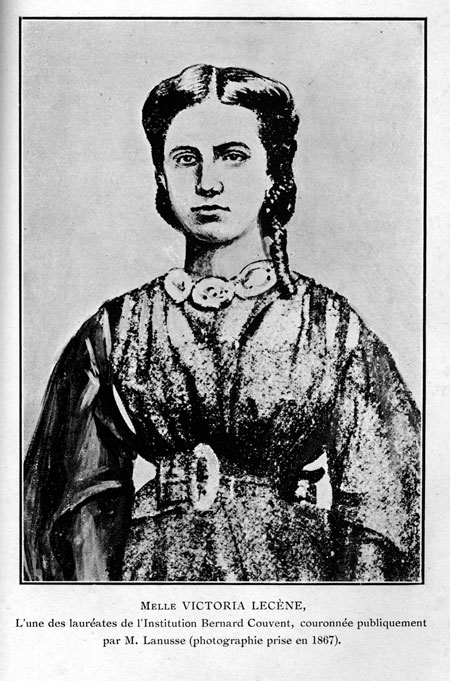
Lanusse took part in the building of a catholic school for poor orphans of color, l’Institution Bernard Couvent. The school was completed in 1848 and Lanusse became its director in 1852, a position he was to occupy until his death. While Lanusse fought with the Confederate Army during the Civil War, his disgust at the treatment that black people received drove him to actively encourage many of them to leave the oppression in Louisiana for more hospitable racial climates. Lanusse’s dedication to the cause of back people is evident in his 1843 creation of L'Album Littéraire, Journal des Jeunes Gens, Amateurs de la Littérature (The Literary Album, A Journal for Young People and Lovers of Literature), a literary newspaper in which Lanusse collaborated with other future contributors to Les Cenelles. This short-lived project defied the ban on published works by people of color in Louisiana and led directly to the publication of Les Cenelles in 1845. The title of this collection of poetry, Les Cenelles, choix de poésies indigènes, alludes to the time-consuming local custom of collecting mayhaw berries in the swamps of Louisiana . While Lanusse was the most important contributor, Les Cenelles also included poems by Pierre Dalcour, Victor Séjour and Camille Thierry. These three men, members of prosperous New Orleans Creole of color families, all chose to pursue their literary careers in France where, in keeping with the ideals of their romantic poetry, they might enjoy relative artistic and social freedom. Dalcour was known for his friendship with Victor Hugo; Séjour served as the private secretary of Napoleon III; and Thierry settled down in Bordeaux, where he published his poetic works. All three men died in France, while Lanusse passed away in New Orleans in 1867 at the age of 55.
See: Régine Latortue and Gleason R.W. Adams. Les Cenelles: A Collection of Poems by Creole Writers of the Early Nineteenth Century. (Boston: G.K. Hall 1979).
Case 12 Gallery:
[Hill La Rare F380 C9 D47 C.2)
![Engraving. “Craegus Aestivalis†(May Haw) in The Silva of North America. Charles Sprague Sargent. (Boston: Houghton, Mifflin and Co., 1892) [Hill McIlheney Collection QK 481 S24 v.4]](/sites/all/files/sc/exhibitions/e-exhibits/creole/case12/large/mayhaw.jpg)
[Hill McIlheney Collection QK 481 S24 v.4]