The View From Outside
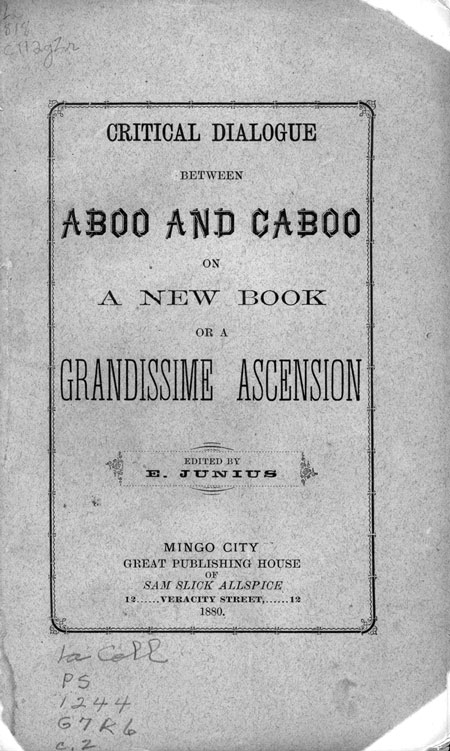
At the same time that Creole New Orleanians were producing music and literature about themselves, several Anglophone writers also based stories and novels on the history and culture of Creole New Orleans. Before the Civil War, the playwright Dion Boucicault’s The Octoroon painted a damning portrait of slavery in Louisiana and served to sway public opinion toward the abolitionist cause. After the war, Kate Chopin and Lafcadio Hearn were prominent among the writers of English-language works set in Louisiana. But George Washington Cable’s extensive writings on New Orleans and Louisiana drew the greatest attention, both from the American audience that read his local color novels and stories, and from Creole readers who took great offense at the way in which Cable represented them in his work. Cable was born in New Orleans in 1847, but the fact that he lived in the Anglophone uptown section of the city and was a devout protestant made him an outsider in the Francophone sections of New Orleans about which he would later write. A manuscript letter from Cable to a Mr. Savini of New Orleans demonstrates Cable’s interest in collecting colorful material about the Creoles for his novels. In Old Creole Days and The Grandissimes, Cable portrays decadent characters in a romanticized New Orleans setting and hints at the racial impurity of the white Creole population of the city. This last point inspired a furious backlash from several prominent Creoles, the most stinging of which is Adrien Rouquette’s A Critical Dialogue Between Aboo and Caboo on a New Book, or A Grandissime Ascension. Rouquette’s satirical critique of The Grandissimes, written as an overheard dialogue between two ghosts on the shore of Lake Ponchartrain, mocks Cable’s attempt to imitate the various accents of New Orleans in his dialogue and takes issue with the fact that Cable’s works “were given as novels and taken for history.â€
Case 4 Gallery:
![Pamphlet. A Critical Dialogue Between Aboo and Caboo on a New Book, or A Grandissime Ascension. Adrien Rouquette. (Mingo City [New Orleans]: Great pubishing house of Sam Slick Allspice, 1880). [Hill Louisiana PS 1244 G7 R6 c.2]](/sites/all/files/sc/exhibitions/e-exhibits/creole/case5/large/aboo.jpg)
[Hill Louisiana PS 1244 G7 R6 c.2]
![MS Letter, George Washington Cable to M. Savini, 1875. in George Washington Cable Miscellany. [Cable George Washington Miscellany, W: 37]](/sites/all/files/sc/exhibitions/e-exhibits/creole/case5/large/cable_letter.jpg)
[Cable George Washington Miscellany, W: 37]
![Engraving. George Washington Cable, in Titcomb Collection. [Titcomb Collection, E: 73, folder 1]](/sites/all/files/sc/exhibitions/e-exhibits/creole/case5/large/cable_portrait.jpg)
[Titcomb Collection, E: 73, folder 1]
![Fiction. Chita: a memory of Last Island. Lafcadio Hearn. (New York, Harper & Brothers, 1889). [Hill Louisiana Rare PS 1917 C5 c.2]](/sites/all/files/sc/exhibitions/e-exhibits/creole/case5/large/chita.jpg)
[Hill Louisiana Rare PS 1917 C5 c.2]
![Fiction. The Grandissimes. A Story of Creole life. George Washington Cable. (New York: C. Scribner’s Sons, 1880). [Hill Louisiana PS 1244. G6 1880]](/sites/all/files/sc/exhibitions/e-exhibits/creole/case5/large/grandissimes.jpg)
[Hill Louisiana PS 1244. G6 1880]
![Engraving. Creole man. in The Grandissimes, a story of Creole Life. George Washington Cable. (New York, C. Scribner’s Sons,1880). [Hill Louisiana PS 1244 G6 1899]](/sites/all/files/sc/exhibitions/e-exhibits/creole/case5/large/grandi.jpg)
[Hill Louisiana PS 1244 G6 1899]
![Broadside. "Boston Museum Broadside" for a performance of The Octoroon. (Boston, 1861) [E: Impr. #1558]](/sites/all/files/sc/exhibitions/e-exhibits/creole/case5/large/octoroon_broadsheet.jpg)
[E: Impr. #1558]
![Fiction. Old Creole Days. George Washington Cable. (New York: C. Scribner’s Sons, 1879). [Hill Louisiana Rare PS 1244 O6 c.1]](/sites/all/files/sc/exhibitions/e-exhibits/creole/case5/large/old_creole_days.jpg)
[Hill Louisiana Rare PS 1244 O6 c.1]