The Creole Family
Creole New Orleans prided itself on its literary, theatrical and musical institutions-- the city supported several French-language newspapers; ballrooms thrived in a city obsessed with dancing; book and music publishers distributed Francophone cultural production to a larger audience; and several French-language theaters and opera houses nurtured the Creole love of high French culture. Auguste Lussan, a French poet and playwright who came to New Orleans in the 1830s to pursue his acting career, wrote La famille créole (The Creole Family). The play opened on February 28, 1837, at the French Theatre of New Orleans and was later published by one of the many French-language presses in the city. This five act drama alternately set in France and Louisiana, tells the story of a family of slave-holding refugees from the Revolution in St. Domingue (Haiti) that find in Louisiana a haven from both the upheaval in the Caribbean and the French Revolution. The existence of the French-language institutions in New Orleans gives the impression of a coherent “creole†population--a Creole Family-- united by a common language and culture. But a closer examination of these literary, musical, and theatrical works shows the conflicted and precarious status of Creole cultural production in New Orleans.
Case 3 Gallery:
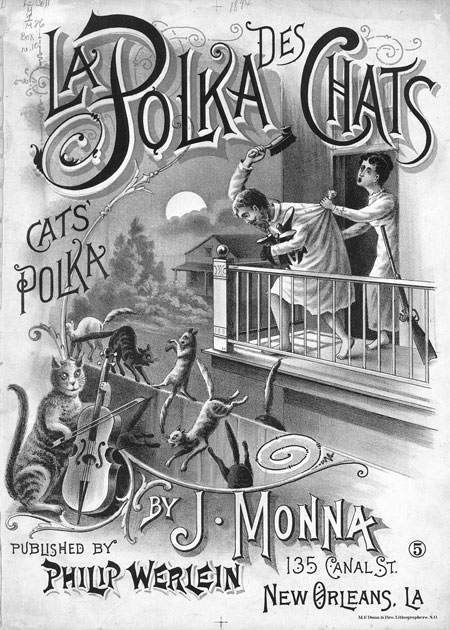
![Sheet Music. "La Polka Des Chats." by J. Monna (New Orleans: P. Werlein, 1894) in Music Collection of New Orleans Imprints. [Hill Louisiana Rare Oversize M1 .M86 Box 7, no.2]](/sites/all/files/sc/exhibitions/e-exhibits/creole/case3/large/chats_polka_cvr.jpg)
[Hill Louisiana Rare Oversize M1 .M86 Box 7, no.2]
![Drama. La famille créole. Auguste Lussan. (New Orleans: Fremaux et Alfred Moret, 1837). [Hill Louisiana Rare PQ 3939. L87 F3]](/sites/all/files/sc/exhibitions/e-exhibits/creole/case3/large/lussan_famille.jpg)
[Hill Louisiana Rare PQ 3939. L87 F3]
![Photographs. New Orleans French Quarter. Mugnier Collection. [Mugnier Collection, U: 105, #7,8,9, 14, 23]](/sites/all/files/sc/exhibitions/e-exhibits/creole/case3/large/mugnier_1.jpg)
[Mugnier Collection, U: 105, #7,8,9, 14, 23]
![Photographs. New Orleans French Quarter. Mugnier Collection. [Mugnier Collection, U: 105, #7,8,9, 14, 23]](/sites/all/files/sc/exhibitions/e-exhibits/creole/case3/large/mugnier_2.jpg)
[Mugnier Collection, U: 105, #7,8,9, 14, 23]
![Photographs. New Orleans French Quarter. Mugnier Collection. [Mugnier Collection, U: 105, #7,8,9, 14, 23]](/sites/all/files/sc/exhibitions/e-exhibits/creole/case3/large/Mugnier_3.jpg)
[Mugnier Collection, U: 105, #7,8,9, 14, 23]
![Photographs. New Orleans French Quarter. Mugnier Collection. [Mugnier Collection, U: 105, #7,8,9, 14, 23]](/sites/all/files/sc/exhibitions/e-exhibits/creole/case3/large/Mugnier_4.jpg)
![Photographs. New Orleans French Quarter. Mugnier Collection. [Mugnier Collection, U: 105, #7,8,9, 14, 23]](/sites/all/files/sc/exhibitions/e-exhibits/creole/case3/large/mugnier_5.jpg)
[Mugnier Collection, U: 105, #7,8,9, 14, 23]
![Engraving. "Vue d'une fenêtre d'hôtel, le dimanche matin." in Almanach de la Louisiane (New Orleans: Francis Bouvain, 1866). [Hill Louisiana AY 72 N4 A54]](/sites/all/files/sc/exhibitions/e-exhibits/creole/case3/large/newspaper.jpg)
[Hill Louisiana AY 72 N4 A54]
![Travel Guide. Historical Sketch Book and Guide to New Orleans. Willam Head Coleman. (New York: W.H. Coleman, 1885). [Hill Louisiana Rare F 379 N5 C7 1885 c.2]](/sites/all/files/sc/exhibitions/e-exhibits/creole/case3/large/sketch.jpg)
[Hill Louisiana Rare F 379 N5 C7 1885 c.2]
![Sheet Music. "Souvenirs Du Bal." (New Orleans: Grunewalds, nd) in New Orleans Music Imprints. [in NO Music Imprints--Hill Louisiana M1 M85 1800]](/sites/all/files/sc/exhibitions/e-exhibits/creole/case3/large/souvenir.jpg)
[in NO Music Imprints--Hill Louisiana M1 M85 1800]
![Engraving. "The Theatres of New Orleans." Scribner's Monthly. Nov 1873. [Hill Rare 051 C33, p.23]](/sites/all/files/sc/exhibitions/e-exhibits/creole/case3/large/theaters.jpg)
[Hill Rare 051 C33, p.23]