Extension Work in the 1920s
Robert Badon
Robert Badon
Pamela Dean: Let me ask you to back up just a little bit and
tell me about the work you did as a county extension agent. What did
that involve?
Robert Badon: Well, today of course, it's much different. In
that day, it was the beginning . . . the Extension Act was passed in
Congress in 1914 and by the time I got into it in 1920, 1919, 1920,
they hadn't done much groundwork. So the county agent didn't have
much of a . . . But it was a day and time when there was a lot of
anthrax in cattle and horses and the disease known commonly as
charbon. And there was a tremendous amount of hog cholera all over
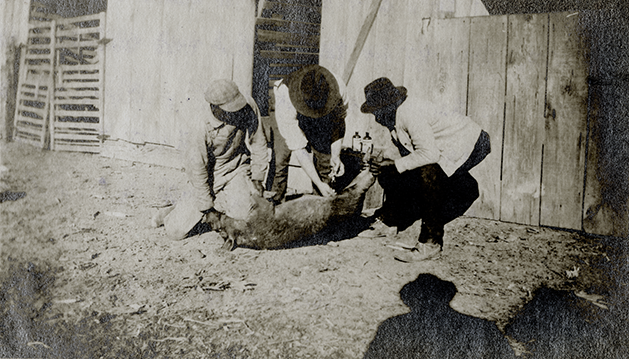
the state. So I spent most of my time vaccinating hogs for hog
cholera and vaccinating cattle and horses and mules for anthrax. So,
but then St. John Plantation is a ten-thousand acre sugar cane farm
in St. Martin Parish and they had never used fertilizer. Nobody in
St. Martin Parish had ever used fertilizer in their work. So I
brought test plots for the first time in the parish using fertilizer
and that was back in 1921.
Dean: So that . . . Were the results impressive? Did they . .
.
Badon: Oh, the results were very, very impressive. They soon
saw how much of an increased tonnage there was in the fertilized
plot that it became standard practice with them. But the common
ordinary farmer, who had very little education if any, they couldn't
see the value of spending hard money in June to get better results
in December. They couldn't see that far.
Dean: I see.
Badon: So it took a long time to get the fertilizer idea over
in the farmers. But that was the main work that county agents did in
the early days.