Revolutionary War documents discovered in LSU Libraries
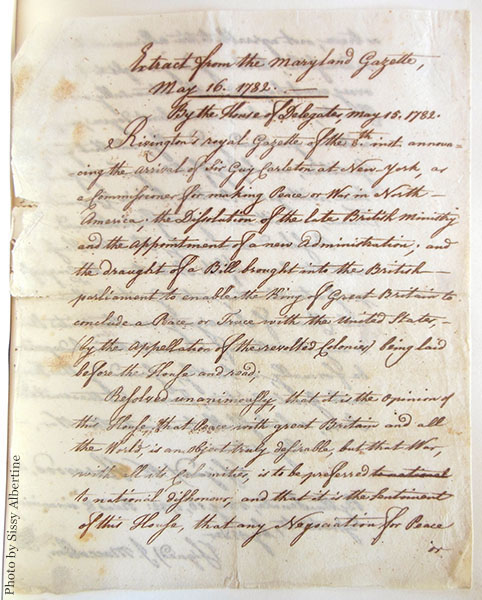
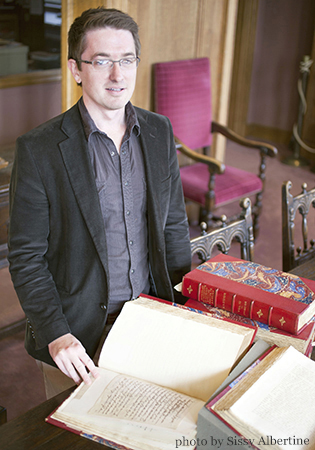 Fifty-seven original letters and other signed documents related to the American Revolution have been discovered in the LSU Libraries' Special Collections. The materials include documents signed by or sent to several members of the Continental Congress, three signers of the Declaration of Independence (Samuel Huntington, George Read, and Benjamin Harrison), and other politicians, diplomats, and military leaders, including Generals Henry Knox, Arthur St. Clair, and Benjamin Lincoln, Washington's second in command, who formally accepted the British surrender at Yorktown in 1781.
Michael Taylor, Assistant Curator of Books for the LSU Libraries' Special Collections, came across the materials. He says that an unidentified collector added them to a large set of facsimile reproductions of Revolutionary War manuscripts produced by the American bibliographer B. F. Stevens in the 1890s. The original documents went unnoticed, Taylor believes, because they were interspersed among the 2,107 facsimiles, which were published in 24 volumes as B.F. Stevens's Facsimiles of Manuscripts in European Archives Relating to America, 1773-1783. The collector also added more than four hundred engravings to the volumes, depicting individuals and events associated with the Revolution.
"In the 19th century, people often 'extra-illustrated' books by inserting prints, letters, autographs, newspaper clippings, and anything else that supplemented the text," Taylor says. He adds that the materials are a good example of how people collected "relics" of the Revolution. "Some of the letters are interesting in themselves, but I think they are more interesting as a group. How did the people who fought the Revolutionary War go from being ordinary men and women to national icons? How did America create its own mythology? These materials tell us something about that process."
Fifty-seven original letters and other signed documents related to the American Revolution have been discovered in the LSU Libraries' Special Collections. The materials include documents signed by or sent to several members of the Continental Congress, three signers of the Declaration of Independence (Samuel Huntington, George Read, and Benjamin Harrison), and other politicians, diplomats, and military leaders, including Generals Henry Knox, Arthur St. Clair, and Benjamin Lincoln, Washington's second in command, who formally accepted the British surrender at Yorktown in 1781.
Michael Taylor, Assistant Curator of Books for the LSU Libraries' Special Collections, came across the materials. He says that an unidentified collector added them to a large set of facsimile reproductions of Revolutionary War manuscripts produced by the American bibliographer B. F. Stevens in the 1890s. The original documents went unnoticed, Taylor believes, because they were interspersed among the 2,107 facsimiles, which were published in 24 volumes as B.F. Stevens's Facsimiles of Manuscripts in European Archives Relating to America, 1773-1783. The collector also added more than four hundred engravings to the volumes, depicting individuals and events associated with the Revolution.
"In the 19th century, people often 'extra-illustrated' books by inserting prints, letters, autographs, newspaper clippings, and anything else that supplemented the text," Taylor says. He adds that the materials are a good example of how people collected "relics" of the Revolution. "Some of the letters are interesting in themselves, but I think they are more interesting as a group. How did the people who fought the Revolutionary War go from being ordinary men and women to national icons? How did America create its own mythology? These materials tell us something about that process."
The LSU Libraries includes the LSU Library and the adjacent Hill Memorial Library. Together, the libraries contain more than 4 million volumes and provide additional resources such as expert staff, technology, services, electronic resources, and facilities that advance research, teaching, and learning across every discipline.