People & Places
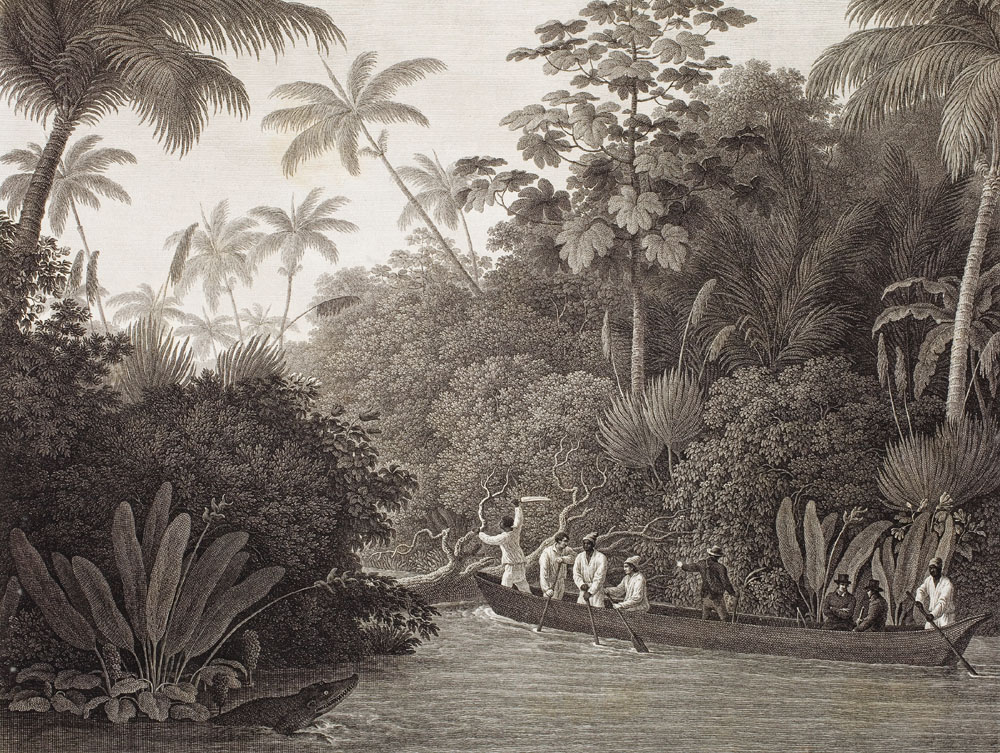
Most early accounts of exploration in the Neotropics focused on the hardships and dangers encountered: survival and the discovery of riches were the point. Beginning with Alexander von Humboldt there was a new emphasis: on the beauty and grandeur of the natural world. The experience is idealized; hardships are obscured; most everything is described as pleasant and inspiring. The image above, from Robert Schomburgk’s Twelve Views of the Interior of Guiana, is typical, as is this awed description: “It appears as if the productive powers of nature, on receding from the poles, had collected themselves in their greatest strength near the equator, spreading their gifts with open hand, rendering every scene more imposing and majestic …. Gigantic trees raise their lofty crowns to a height unknown in the European forests, and display the greatest contrasts in the form and appearance of their foliage. Lianas cling to their trunks, interlace their wide spreading branches, and having reached their summit, with aërial roots descend again towards the ground and appear like the cordage of a ship. Clusters of palm trees, of all vegetable forms the most imposing, rise in grandeur above the surrounding mass, waving their pinion-like leaves in the soft breeze. . . The calm of the surrounding atmosphere, where frequently not a breath of wind agitates the foliage, not a cloud veils the azure vault of heaven, contrasts strongly with the hum of animated nature. The Colibri, with its metallic lustre, passes rapidly from from blossom to blossom, sipping the nectar of fragrant flowers . . . The ancient forest of noble trees re-echoes with the notes of feathered songsters. The plumage of the splendid macaws and parrots, perched on boughs, perhaps illumined by the beans of a setting sun, richly mingles with the brilliant and bright green foliage†(p. [1]).

Maximilian Wied-Neuwied was charmed by the forests in Northeastern Brazil: “Our stay on the Rio Doce was certainly one of the most interesting parts of my travels in Brazil; for on this river, which is so rich in fine scenery and remarkable productions, the naturalist finds employment for a long time, and the most diversified pleasures†(Wied 1820, p. 182-3). Depicted in the stern of the boat, arms casually crossed in a full coat and beaver top-hat, Wied looks the part of an aristocrat on a charming excursion: “The weather was very fine, and when we had become accustomed to the rocking of the narrow canoe, caused by the soldiers walking backwards and forwards to push it along, we found the excursion very agreeable†(ibid., 175). He described the birds observed along the river: “Here it was that we first saw in their wild state the magnificent macaws . . . which are among the chief ornaments of the Brazilian forests; we heard their loud screaming voices, and saw these splendid birds soaring above the crowns of the lofty sapucaya trees. We recognized them at a distance by their long tails, and their glowing red plumage shown with dazzling splendour in the beams of the unclouded sun. Perroquets, maracanas, maitaccas, tiribas, curicas, camutangas, nandayas, and other species of parrots, flew, loudly screaming, in numerous flocks from bank to bank . . .†(ibid., 176). Unfortunately, the lush scenery and abundant wildlife experienced by Weid are gone; today the Rio Doce valley is almost completely deforested.
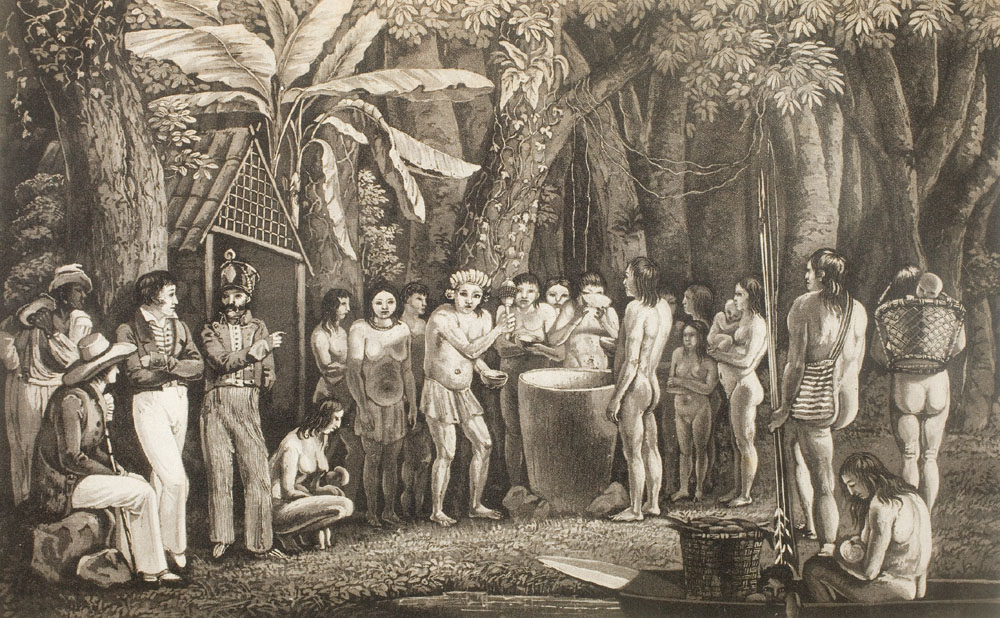
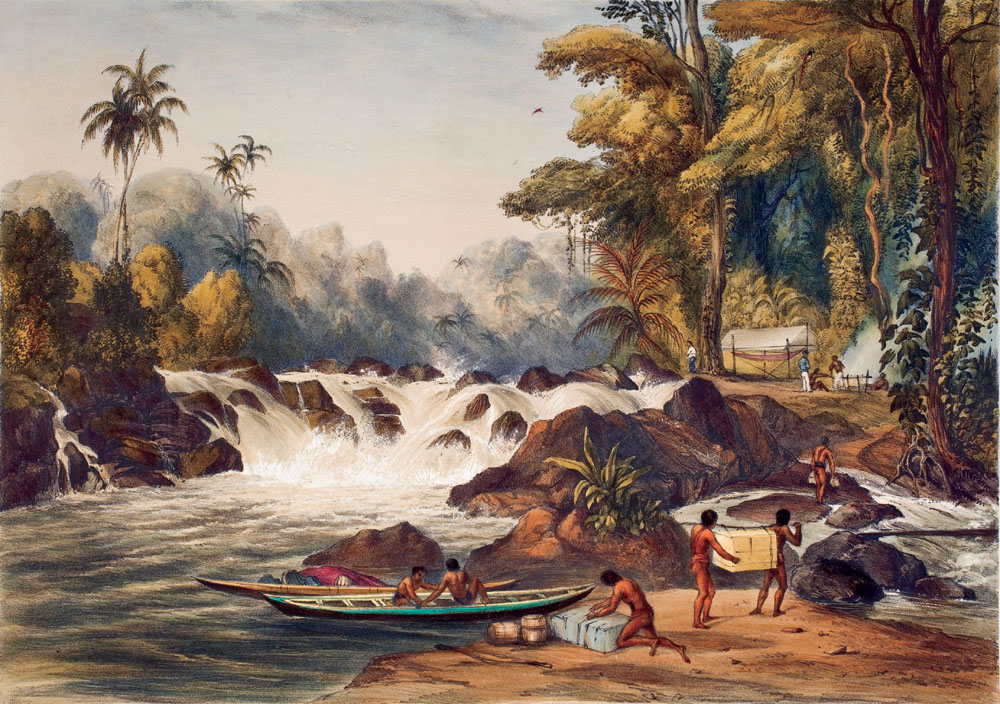
Although it is fair to say that no European considered the Indian his equal, the arrival of naturalists brought men who were more curious than cruel. They used Indian skills, such as woodsmanship and knowledge of local conditions, to assist them in their work. In the previous image from Schomburgk (plate 3), natives are employed as boatmen and in setting up camp. Here, Johann von Spix, leaning against a tree and looking as relaxed and well-groomed as if he were at home in Bavaria, witnesses the ritual consumption of a local beverage. Spix himself drank some, but was “filled with disgust.†Though he was not vicious, his attitude of superiority is complete: “Still and docile in the service of the whites; unremittingly persevering in any work assigned to him; not to be excited by any treatment to anger, though he may too long cherish revenge; he is born, as the colonists are used to say, only to be commanded†(Spix 1824, vol. 2, p. 242).
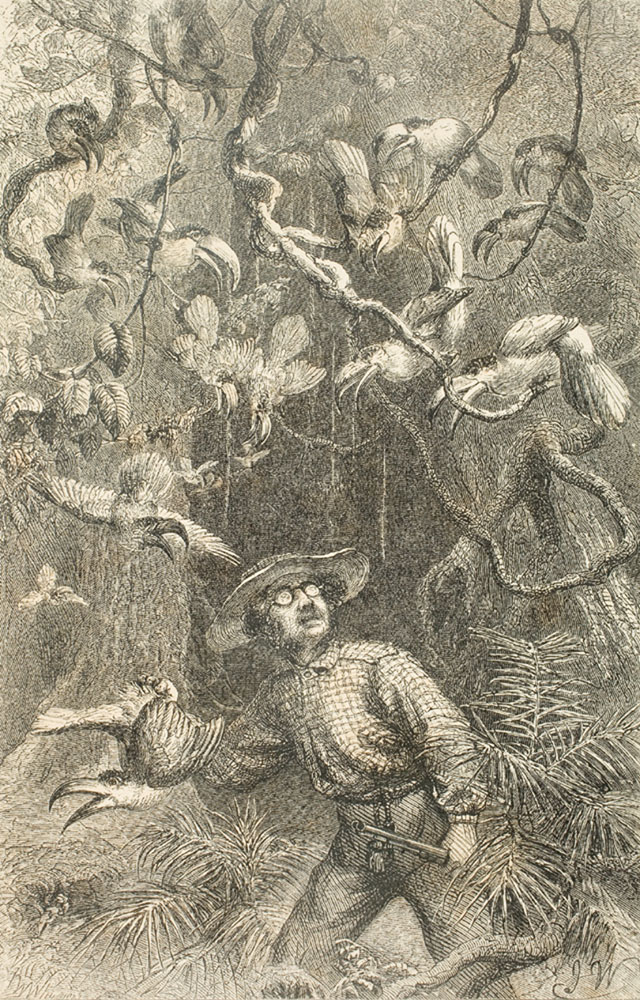
Henry Walter Bates mobbed by curl-crested aracaris, not amused by one of their tribe being shot – a vivid image of the collecting naturalist as a “solitary stranger on a strange errand†(Bates 1863, vol. 2, p. 178). His description of “one tropical day†begins with ornithology at dawn, “when all nature was fresh;†entomology in the late morning and early afternoon, “the best time for insects being a little before the greatest heat of the day;†then, “fatigued with our ramble†a long rest in hammocks (ibid., vol. 1, pp. 61- 64). Of course, having collected specimens all day, Bates had then to prepare them: “Each bird (macaws) took me three hours to skin, and I was occupied with these and my other specimens every evening until midnight . . . working on the roof of my cabin by the light of a lamp†(ibid., vol. 2, p. 139). Over time (he was in South America eleven years) “the want of intellectual society, and of the varied excitement of European life,†took its toll on him: “I was obliged, at last, to come to the conclusion that the contemplation of nature alone is not sufficient to fill the human heart and mind†(ibid., vol. 2, p. 186).
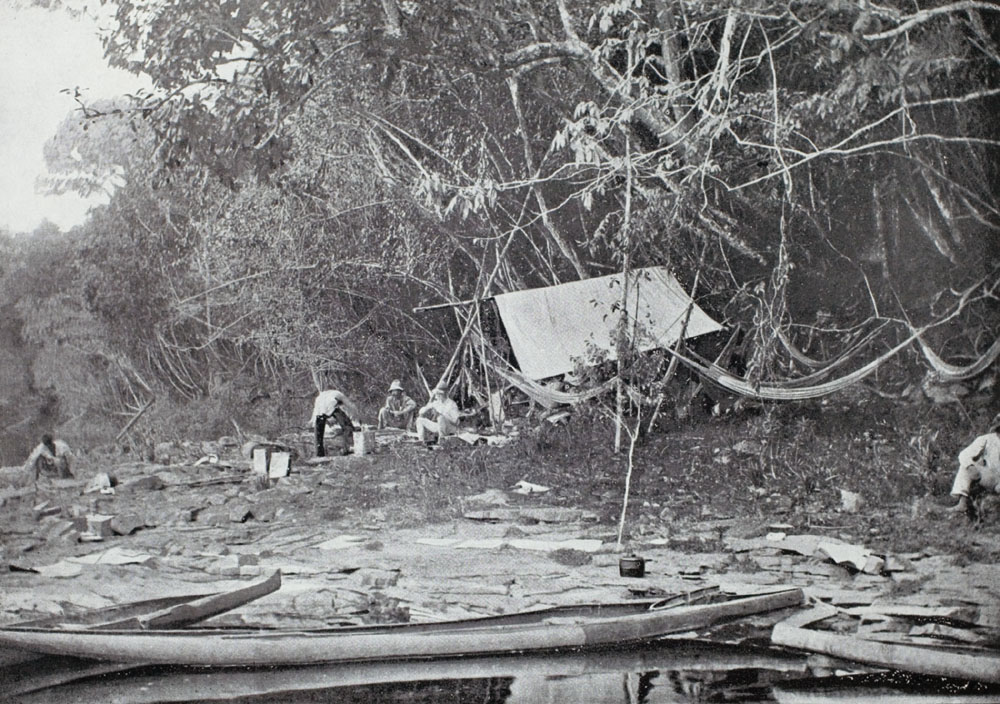
This photo, from Charles Chubbs’s Birds of British Guiana (London, 1916-21), is reminiscent of the grand image from Schomburgk. It also depicts a camping scene on a stream in British Guiana, but the impression made is quite different – it looks like hard and rather uncomfortable work for all involved.
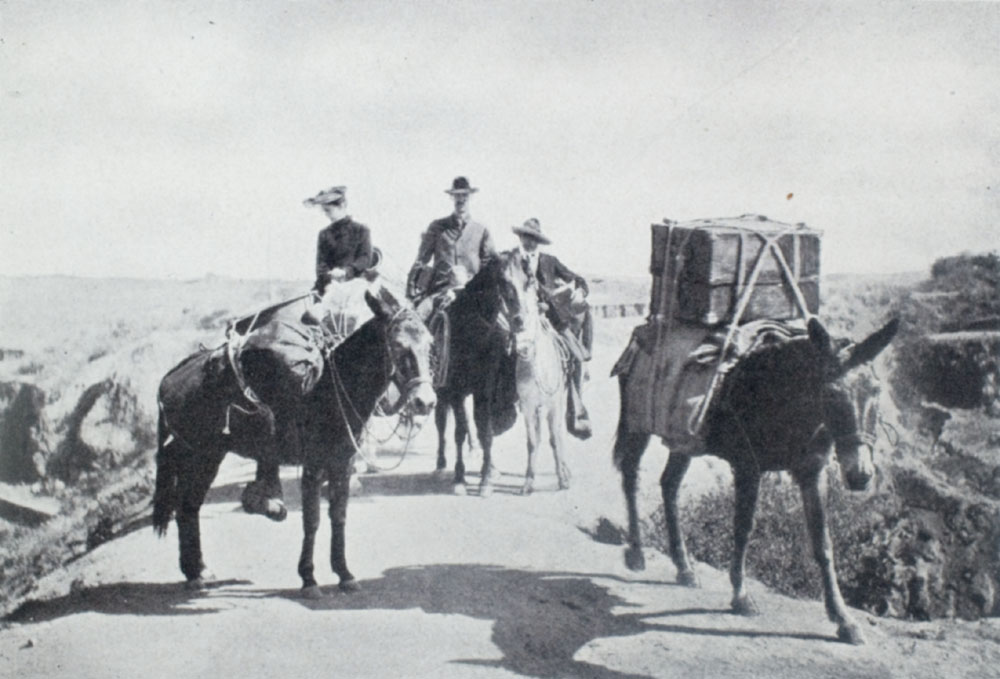
Blair Beebe was one of the first women to appear in the largely male world of Neotropical ornithology. Two Bird Lovers in Mexico describes her honeymoon trip with William Beebe, and this image shows them just before a fairly harrowing part of their trip: †The side of the barranca (ravine) is steep and rocky, and the way to the bottom is treacherous and slow. The sure-footed mules felt their way at each step, and we leaned far back against the rear pommel of the great saddles, the shoulders of the horses working laboriously, the animals hanging back in the steep places. With a final reckless push we tore down the last slope, shouting out in English and Spanish with the joy of the journey’s end, nor did we pull rein until our steeds were deep in the streambed.†(Beebe 1905, 130). She offered fashion advice for the camping woman: “When the last farewell to civilization is said, and the woman who goes camping sets forth on the trail to be a wilderness woman indeed, she will find that a very simple wardrobe will be all that is necessary. First and most important is a divided shirt of whipcord or courduroy. No one should attempt to ride side-saddle over these steep mountain trails; indeed the woman who does not intend to ride cross-saddle should never attempt a camping-trip in the wilds of Mexico. . . .A pair of canvas hunter-leggings . . . were the joy and comfort of my life; for whatever Mexico may lack, it is not thorns. . . . But I hope my camping woman will not mar her pleasure by wearing her veil over her face. A wild gallop over the plains on horseback loses much of its charm if there is anything between one’s face and the pure invigorating mountain breeze. And after all, a little honest tan is a good thing!†(ibid., 367-8).
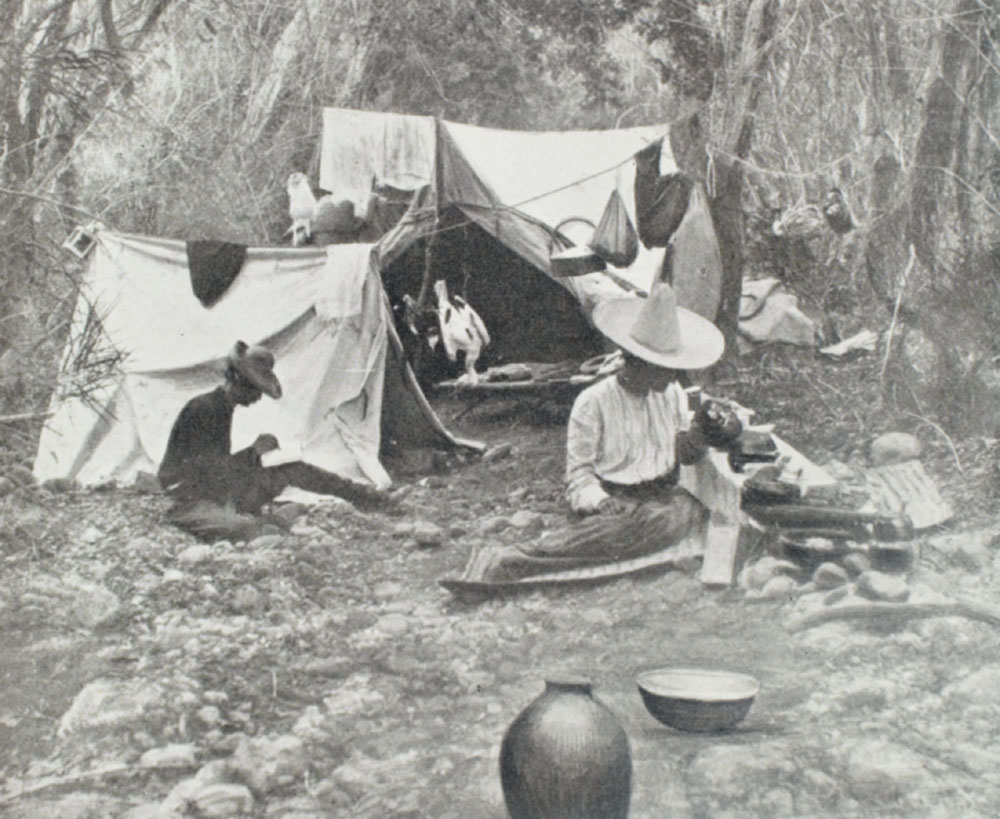
In Blair Beebe’s opinion, “the cheapest kind of a tent will suffice; for during the winter season in Mexico, every day is like Indian summer – bright and cloudless. . . We did not take tent-poles. A stout rope stretched between two trees answers every purpose, which reminds me that, like pins and strings, rope is a thing of which one can never have too much when camping (ibid 368-9). This image, also from Two Bird Lovers in Mexico, seems a bit too artful to be accidental. Note the white monkey perched by the tent in the background.
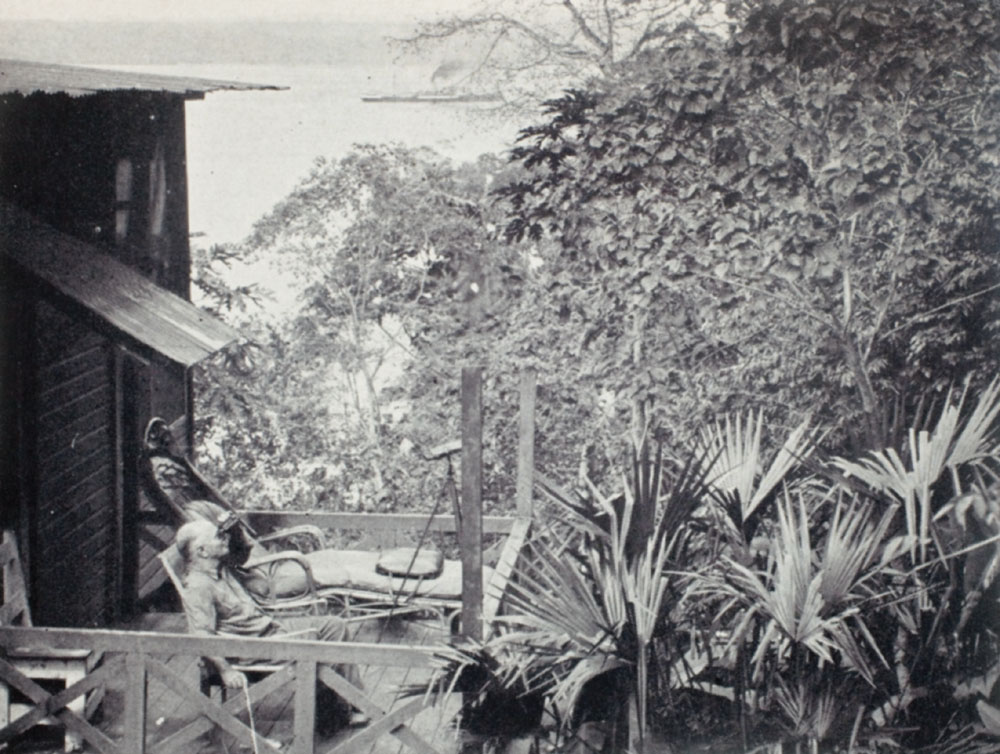
Two places for studying birds, both described as “castles†by their proprietors. William Beebe’s “jungle castle†was the last whim of Juan Vincente Gómez, a Venezuelan dictator. Abandoned, unfinished, upon Gomez’ death in 1935, it was a vast edifice in a state of decay, but perfect for Beebe’s purposes: “On many expeditions in many different lands, with hammock, blanket and camp outfit, I would have welcomed the primitive shelter of Rancho Grande as palatial. But as the early days of mere collecting gave place to watching and studying living creatures, there came a greater reason for comfortable beds, healthful food and an adequate laboratory with easy access of wildlife in its own haunts. . . Here was comfort, space, daylight, electricity and refrigeration (Beebe 1949, 67-8, 89). Frank Chapman’s abode – an “air castle†he called it – was on a smaller scale, but created to the same end. Perched in the trees, it afforded him solitude and convenience. “The Balcony,†pictured above, included a reclining “Bliss chair,†tripod-mounted 24x binoculars, and an outdoor shower. “In the dry season, concealed, I can bathe in either sun or shower or both combined. . . †he wrote. “The forest is only twenty feet away, just far enough to give a foreground and permit of the ready focusing of glasses on the birds and mammals that frequent the outer trees†(Chapman 1938, 15).
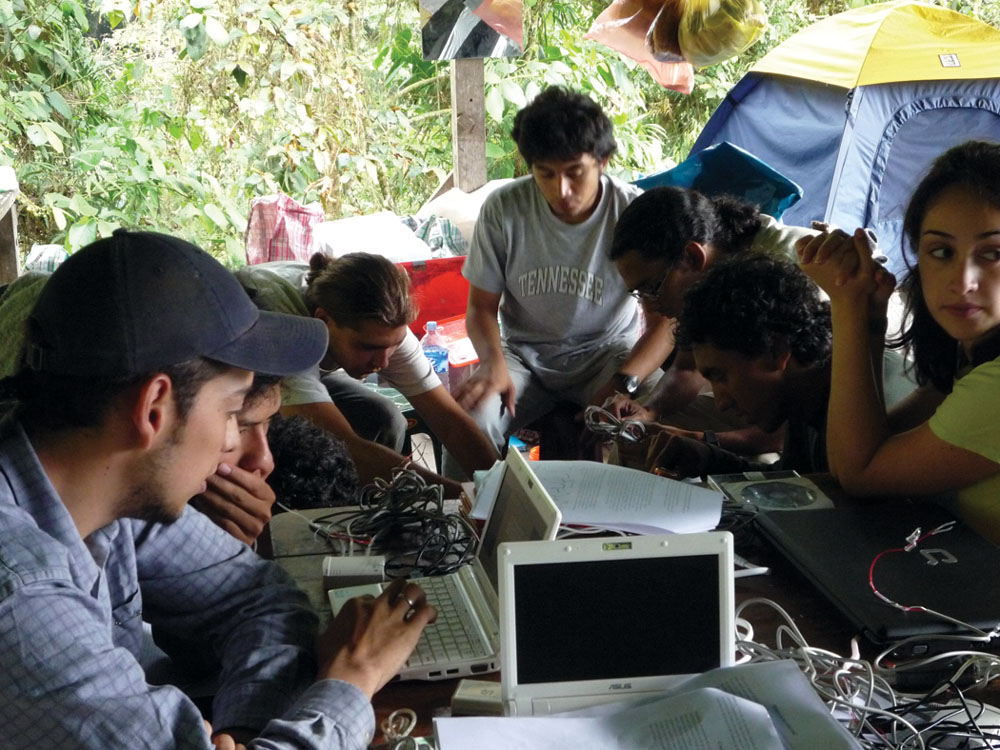
Field research today. A PhD candidate at the University of Florida, Gustavo Londano, recently posted an ad for volunteer assistants to help him with his dissertation on “Avian Nesting Ecology along an Elevation Gradient, Manu National Park, Peru.†He is candid about the conditions: “This study require mainly search and monitor nests, behavioral observations, mist-netting, and banding. We will be working six days a week between 6:00 am and 5:30 pm, and on occasion data entry will take place during the night. Communication is limited, we can have between 2 and 3 weeks without email or phone access. Applicants should be in good physical shape, able to work well in a group setting,and be willing to work long hours (10 hours per day under difficult conditions) . . . I personally prefer volunteers with previous experience with mist nets, nest searching, and that can live happy in uncomfortable conditions (camping and cooking for 4 months). You should expect to be wet, bit by insects (especially mosquitoes) and have a limited diet of rice, pasta, legumes, cassava, plantain, and fresh vegetables.†He asks for a letter, “explaining why you want this difficult job.†On Londano’s website his previous assistants tell why: “the single greatest experience of my life;†“both the most difficult and the most rewarding job I’ve ever had.†And, waxing a bit more philosophical, “the forest doesn’t offer its wisdom and beauty for free. For this job, one needs a strong body to hike across trailless hills all day and haul pack-loads of food for miles. Perhaps even more important, however, one needs a strong mind. Aside from clouds of mosquitoes, biting flies, bamboo spikes, and wasp stings, it can be very frustrating spending weeks without finding what you search for all day long. But when you finally find one of these perfectly constructed nests with eggs inside, it is a true celebration.â€ÂÂÂ
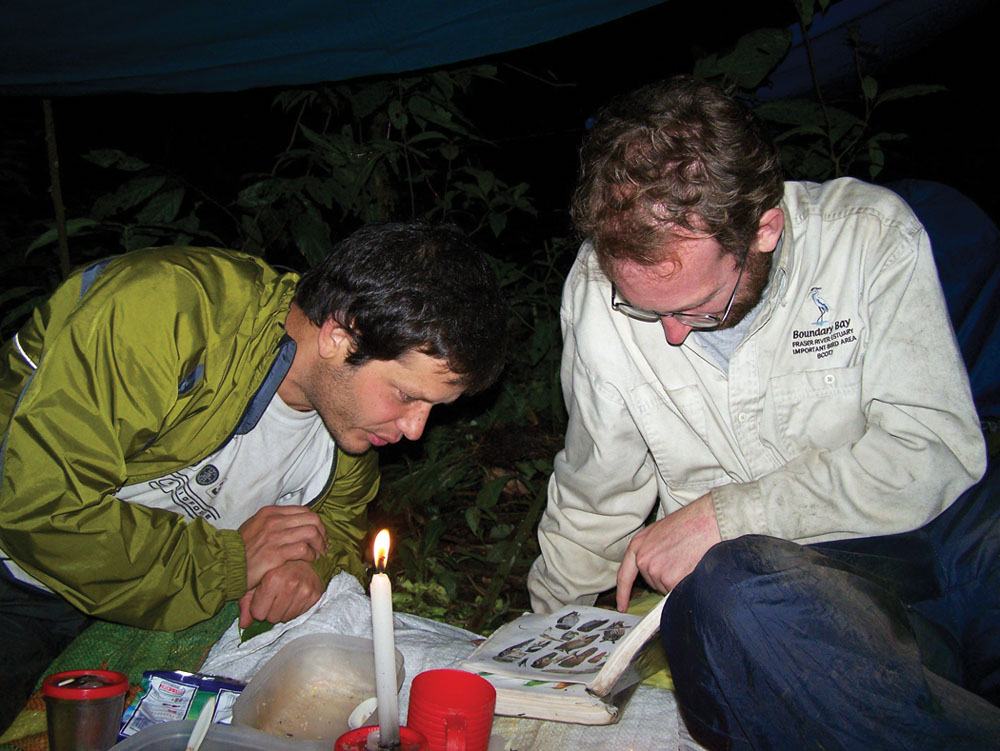
Candles and computers in camp. Manu Nationa