May 31, 1983
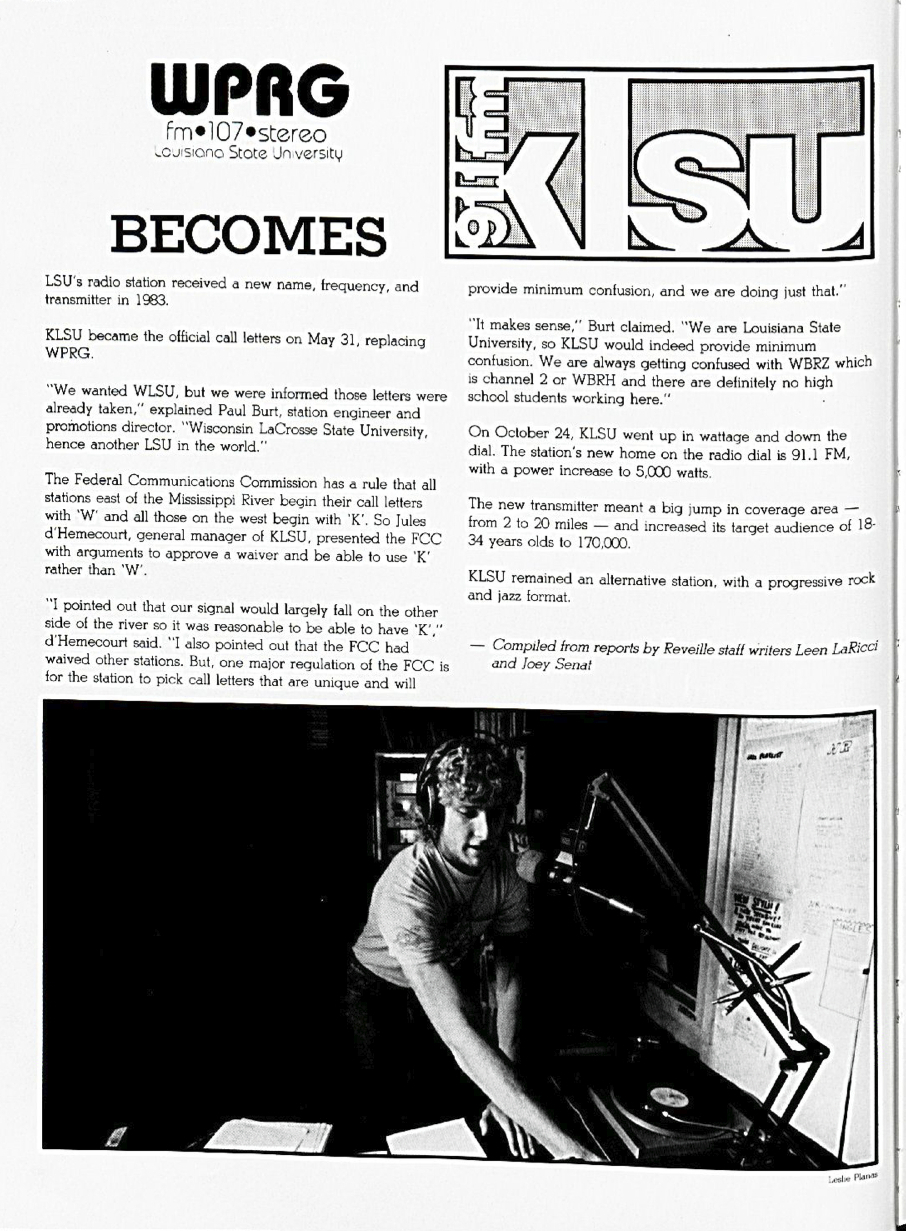
The station call letters change from WPRG to KLSU.
Dez Crawford, a KLSU deejay from 1980 to 1983, speaks about her late husband and former
station manager David Crawford and his successful petition to Congressman Billy Tauzin to
change the station call letters. Dez Crawford Oral History Interview, Mss. 4700.2593, LLMVC,
LSU Libraries, Baton Rouge, La.
View Transcript
DEZ CRAWFORD: He [David Crawford, Dez Crawford's late husband] wanted the radio
station not to be the orphan, red-haired stepchild of the university. And he
struggled to get funding. Things like chairs . . . I mean, everything from chairs to
tape, to degaussers, to a microphone that didn't collapse every time you put it up
in the air [laughs]. To finally successfully lobbying Congressman Billy Tauzin to
get a power increase for the station, which we already had in hand. He worked very
hard for that. He went to Congressman Tauzin and said, you know, "Right now, we're
WPRG." We used the PRG which was randomly thrown at us when WLSU . . . Somebody
didn't do the paperwork, and we lost WLSU to the University of Wisconsin at
Lacrosse. WLSU, Wisconsin Lacrosse State University, because somebody didn't bother
to re-apply for the name. I don't recall what year that was, but that was a couple
years before he [Dave] started. And he went to Billy Tauzin and said, "Look, we're
like . . . You can throw a rock from the Mississippi River from the edge of campus.
The "K" and "W" border is right there. Can you petition the FCC for an exemption?"
And Congressman Tauzin did and we got that exemption. That's how we got KLSU back.
And Wisconsin Lacrosse State University had to settle for something else. And
because Congressman Tauzin was so magnanimous, he spoke to the FCC in this very
compelling way to make them say that, you know, "We had this first and we want it
back."
My understanding is that that was a very low wattage station that basically
broadcast to the dorms. And we were trying to do something and expand our influence
on the community and provide more coverage and to expand the School of Journalism.
He made some very compelling arguments. Dave wrote most of the arguments that were
presented to the FCC, and he worked with Congressman Tauzin and we got . . . Thanks
to Dave, we got KLSU back.
Dez Crawford, a KLSU deejay from 1980 to 1983, speaks about her late husband and former station manager David Crawford and his successful petition to Congressman Billy Tauzin to change the station call letters. Dez Crawford Oral History Interview, Mss. 4700.2593, LLMVC, LSU Libraries, Baton Rouge, La.
View Transcript
DEZ CRAWFORD: He [David Crawford, Dez Crawford's late husband] wanted the radio
station not to be the orphan, red-haired stepchild of the university. And he
struggled to get funding. Things like chairs . . . I mean, everything from chairs to
tape, to degaussers, to a microphone that didn't collapse every time you put it up
in the air [laughs]. To finally successfully lobbying Congressman Billy Tauzin to
get a power increase for the station, which we already had in hand. He worked very
hard for that. He went to Congressman Tauzin and said, you know, "Right now, we're
WPRG." We used the PRG which was randomly thrown at us when WLSU . . . Somebody
didn't do the paperwork, and we lost WLSU to the University of Wisconsin at
Lacrosse. WLSU, Wisconsin Lacrosse State University, because somebody didn't bother
to re-apply for the name. I don't recall what year that was, but that was a couple
years before he [Dave] started. And he went to Billy Tauzin and said, "Look, we're
like . . . You can throw a rock from the Mississippi River from the edge of campus.
The "K" and "W" border is right there. Can you petition the FCC for an exemption?"
And Congressman Tauzin did and we got that exemption. That's how we got KLSU back.
And Wisconsin Lacrosse State University had to settle for something else. And
because Congressman Tauzin was so magnanimous, he spoke to the FCC in this very
compelling way to make them say that, you know, "We had this first and we want it
back."
My understanding is that that was a very low wattage station that basically
broadcast to the dorms. And we were trying to do something and expand our influence
on the community and provide more coverage and to expand the School of Journalism.
He made some very compelling arguments. Dave wrote most of the arguments that were
presented to the FCC, and he worked with Congressman Tauzin and we got . . . Thanks
to Dave, we got KLSU back.