Summer 1949
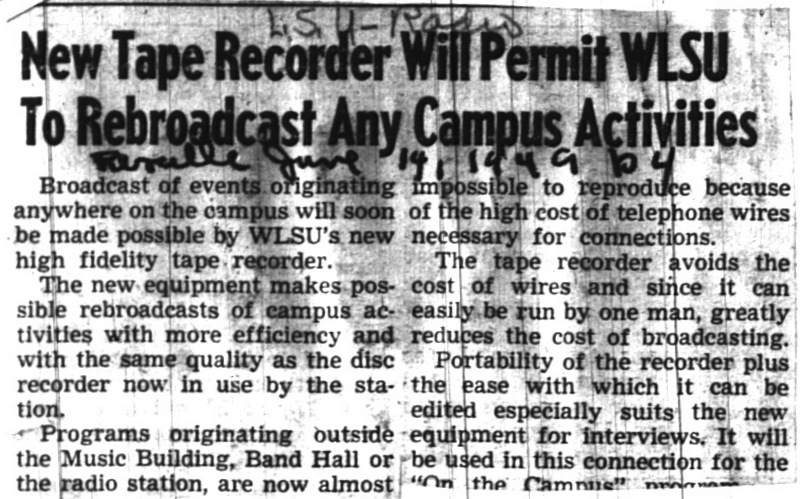
WLSU begins using high-fidelity tape recorders to rebroadcast campus activities from anywhere on
campus. The station was previously using a disc recorder and telephone wires to broadcast events
from the Music and Dramatic Arts building and the Band Hall.
Lucile Ruby Woodard recalls the difficulties of broadcasting with disc recorders and the
arrival of magnetic tape recorders. Lucile Ruby Woodard Oral History Interview, Mss.
4700.0826, LLMVC, LSU Libraries.
View Transcript
LUCILE WOODARD: Well, of course, if you can imagine what it would be like to develop
programming without magnetic tape recorders [laughs]. When we wanted to record a
concert done by LSU Music School --and they were worth recording--we had to cut them
on a disc, by telephone line, from the station to the music building. Those were
recorded on fifteen-inch wax disks.
JACK FISER: Platters?
WOODARD: Platters. We tampered with wire recorders for a while but as you know . . .
FISER: I remember those things.
WOODARD: . . . as you know, [laughs] they were a headache. It was very difficult to
edit. When you got to the magnetic tape where there was something you didn't like,
you could just cut it out and splice it back together again. All of those advantages
of magnetic tape, they're a real boon. We take it for granted now.
FISER: Oh yes.
WOODARD: Audio tape and video tape. But what a great thing it was for broadcasting
when magnetic tape came in. But that was one of our big, big problems.
Lucile Ruby Woodard recalls the difficulties of broadcasting with disc recorders and the arrival of magnetic tape recorders. Lucile Ruby Woodard Oral History Interview, Mss. 4700.0826, LLMVC, LSU Libraries.
View Transcript
LUCILE WOODARD: Well, of course, if you can imagine what it would be like to develop
programming without magnetic tape recorders [laughs]. When we wanted to record a
concert done by LSU Music School --and they were worth recording--we had to cut them
on a disc, by telephone line, from the station to the music building. Those were
recorded on fifteen-inch wax disks.
JACK FISER: Platters?
WOODARD: Platters. We tampered with wire recorders for a while but as you know . . .
FISER: I remember those things.
WOODARD: . . . as you know, [laughs] they were a headache. It was very difficult to
edit. When you got to the magnetic tape where there was something you didn't like,
you could just cut it out and splice it back together again. All of those advantages
of magnetic tape, they're a real boon. We take it for granted now.
FISER: Oh yes.
WOODARD: Audio tape and video tape. But what a great thing it was for broadcasting
when magnetic tape came in. But that was one of our big, big problems.