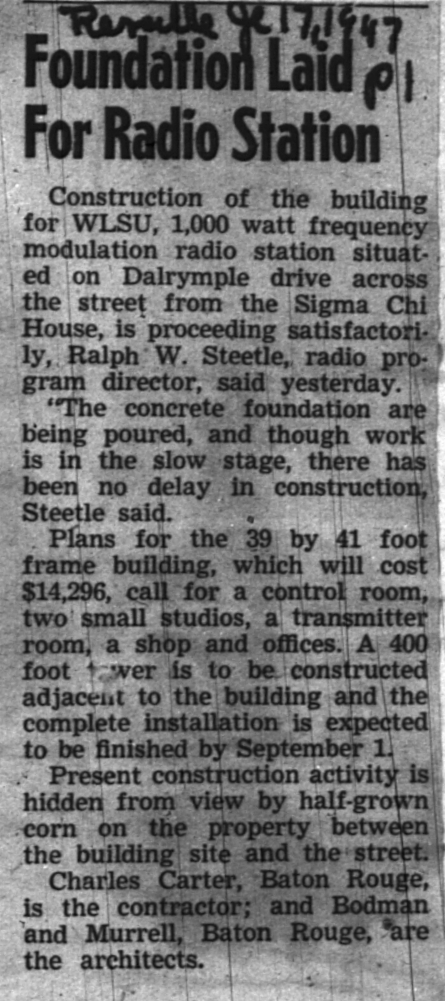
May 1947
New station construction begins on Dalrymple Drive across from the Sigma Chi house and Ralph Steetle
returns to LSU as WLSU Radio Director.
Ralph Steetle discusses returning to LSU in 1947 to develop FM radio station WLSU and the
type of programming that WLSU broadcasted. Ralph Steetle Oral History Interview, Mss.
4700.0660, LLMVC, LSU Libraries.
View Transcript
RALPH STEETLE: Returned from the navy to my job which was held for me at the
Department of State. They wanted me back . . . And to look at LSU which also wanted
me back. So I was on equal leave from both of them. I chose the low bidder and I
came back to the university. Because at this time, frequency modulation was being
developed and I had a great interest in developing it and using it for education and
for university extension purposes.
RON ROSS: This is what we call FM radio?
STEETLE: FM radio. And this resulted in my return to the university. It would be
about 1947 that I began the construction of station WLSU. I think it was probably
the . . . one of the first of the non-commercial frequency modulation stations in
the South. And the equipment we got was from the inventor of FM, Major Armstrong,
and it was all extremely high-quality stuff. And we began relaying programs. I
remember a symphony that was broadcast in New Jersey by Major Armstrong, picked up
by my engineer in New Orleans, sent to our tower at LSU, and rebroadcast.
So we began with a serious interest in music. One of our most significant programs
was "Music in American Life." We were an active role in extending Agricultural
Extension. We had a special project in which we did a farm and home hour in Cajun,
and this was very exciting. That was before the station--we used commercial radio
stations. It was an exciting time, and I'm sorry the university, in my departure for
other things, somehow lost its radio station just when things began to become very
significant. And National Public Radio made that station very important, had it
still been in existence.
ROSS: That is true. Where was WLSU? Was it still in the Music and Dramatic Arts
building or was it . . . ?
STEETLE: The studio building was over at Dalrymple Drive, right on the edge of the
lake. The studio and the transmitter building combination, small but very useful. I
miss it. I'm sorry it's gone.
ROSS: So the building is gone,or the station?
STEETLE: I believe the station is gone. Probably the building, too.
ROSS: So how long were you involved in the creation of WLSU? How long did you stay
to help run it?
STEETLE: I stayed until 1951, so that would be '47 to '51. And then I was asked to
go and help develop public television.
Ralph Steetle discusses returning to LSU in 1947 to develop FM radio station WLSU and the type of programming that WLSU broadcasted. Ralph Steetle Oral History Interview, Mss. 4700.0660, LLMVC, LSU Libraries.
View Transcript
RALPH STEETLE: Returned from the navy to my job which was held for me at the
Department of State. They wanted me back . . . And to look at LSU which also wanted
me back. So I was on equal leave from both of them. I chose the low bidder and I
came back to the university. Because at this time, frequency modulation was being
developed and I had a great interest in developing it and using it for education and
for university extension purposes.
RON ROSS: This is what we call FM radio?
STEETLE: FM radio. And this resulted in my return to the university. It would be
about 1947 that I began the construction of station WLSU. I think it was probably
the . . . one of the first of the non-commercial frequency modulation stations in
the South. And the equipment we got was from the inventor of FM, Major Armstrong,
and it was all extremely high-quality stuff. And we began relaying programs. I
remember a symphony that was broadcast in New Jersey by Major Armstrong, picked up
by my engineer in New Orleans, sent to our tower at LSU, and rebroadcast.
So we began with a serious interest in music. One of our most significant programs
was "Music in American Life." We were an active role in extending Agricultural
Extension. We had a special project in which we did a farm and home hour in Cajun,
and this was very exciting. That was before the station--we used commercial radio
stations. It was an exciting time, and I'm sorry the university, in my departure for
other things, somehow lost its radio station just when things began to become very
significant. And National Public Radio made that station very important, had it
still been in existence.
ROSS: That is true. Where was WLSU? Was it still in the Music and Dramatic Arts
building or was it . . . ?
STEETLE: The studio building was over at Dalrymple Drive, right on the edge of the
lake. The studio and the transmitter building combination, small but very useful. I
miss it. I'm sorry it's gone.
ROSS: So the building is gone,or the station?
STEETLE: I believe the station is gone. Probably the building, too.
ROSS: So how long were you involved in the creation of WLSU? How long did you stay
to help run it?
STEETLE: I stayed until 1951, so that would be '47 to '51. And then I was asked to
go and help develop public television.