Fall 1946
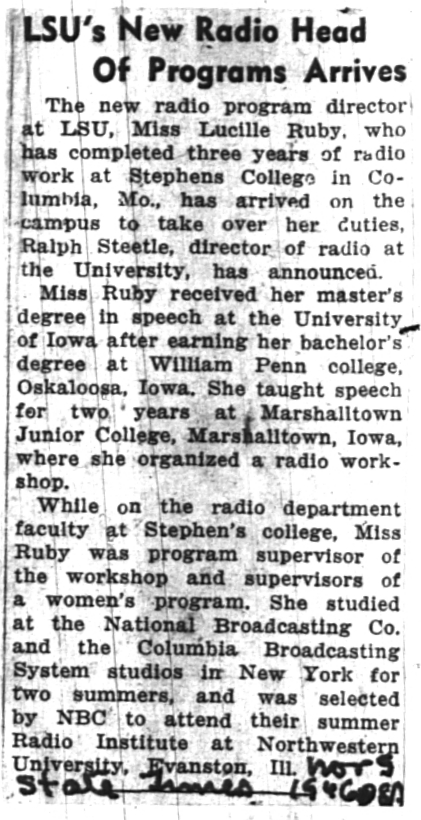
Lucille Ruby Woodard becomes radio program director.
Lucile Ruby Woodard, former LSU Professor Emeritus of Speech and WLSU Program Director,
speaks about the beginnings of the radio station and her involvement with Dr. Joseph
Brouillette, Dr. Harley Smith, and Ralph Steetle.
View Transcript
JACK FISER: Tell me about the job that you came into when they started the station
here. What was here at the time?
LUCILE WOODARD: Well, I don't know just exactly what the date was. But when they
started radio at LSU, Harley Smith worked with the Speech Department and with the
General Extension Division. It's now Continuing Education, but at that time it was
called General Extension under Dr. [Joseph W.] Brouillette. Harley and Dr.
Brouillette had been working in developing this area of radio. One of Harley's
students was Ralph Steetle. So after Harley left, Ralph took over and went full time
with the General Extension Division in developing radio.
I came here when the thousand-watt FM station was in the planning stage. I was
brought here as Program Director of that FM station. I wore two hats. I taught
half-time in the Speech Department . . . broadcasting courses in the Speech
Department. Then I was half-time with General Extension in production as Program
Director of the radio station. So that's how I came to Louisiana.
FISER: Well, you were here a while working under Steetle at the radio
station.
WOODARD: Yes. Yes.
FISER: I was around at that time then, too. I remember Steetle very well. I think he
was a Midwesterner. He was from Ohio, or something.
WOODARD: He was from Ohio.
FISER: And later became head of educational television for the state of
Oregon.
WOODARD: That's right.
FISER: He's now retired from there. Tell me some of the problems that you faced in
those days . . . Very little help, I'm sure.
WOODARD: Well, of course, there were a number of universities who had radio stations
at that time. They were AM stations. I worked with the one at the University of Iowa
when I was there. Wisconsin, Iowa, Iowa State College, now Iowa State University,
Illinois . . . were some that just come to my mind that had operating AM stations at
that time. But LSU . . . Baton Rouge did not have an AM frequency available at that
time for an AM station for education. So when FM frequencies were set aside for the
universities and other educational institutions, they decided that LSU should have
such a station. That was when Ralph and Dr. Brouillette started building one.
Lucile Ruby Woodard, former LSU Professor Emeritus of Speech and WLSU Program Director, speaks about the beginnings of the radio station and her involvement with Dr. Joseph Brouillette, Dr. Harley Smith, and Ralph Steetle.
View Transcript
JACK FISER: Tell me about the job that you came into when they started the station
here. What was here at the time?
LUCILE WOODARD: Well, I don't know just exactly what the date was. But when they
started radio at LSU, Harley Smith worked with the Speech Department and with the
General Extension Division. It's now Continuing Education, but at that time it was
called General Extension under Dr. [Joseph W.] Brouillette. Harley and Dr.
Brouillette had been working in developing this area of radio. One of Harley's
students was Ralph Steetle. So after Harley left, Ralph took over and went full time
with the General Extension Division in developing radio.
I came here when the thousand-watt FM station was in the planning stage. I was
brought here as Program Director of that FM station. I wore two hats. I taught
half-time in the Speech Department . . . broadcasting courses in the Speech
Department. Then I was half-time with General Extension in production as Program
Director of the radio station. So that's how I came to Louisiana.
FISER: Well, you were here a while working under Steetle at the radio
station.
WOODARD: Yes. Yes.
FISER: I was around at that time then, too. I remember Steetle very well. I think he
was a Midwesterner. He was from Ohio, or something.
WOODARD: He was from Ohio.
FISER: And later became head of educational television for the state of
Oregon.
WOODARD: That's right.
FISER: He's now retired from there. Tell me some of the problems that you faced in
those days . . . Very little help, I'm sure.
WOODARD: Well, of course, there were a number of universities who had radio stations
at that time. They were AM stations. I worked with the one at the University of Iowa
when I was there. Wisconsin, Iowa, Iowa State College, now Iowa State University,
Illinois . . . were some that just come to my mind that had operating AM stations at
that time. But LSU . . . Baton Rouge did not have an AM frequency available at that
time for an AM station for education. So when FM frequencies were set aside for the
universities and other educational institutions, they decided that LSU should have
such a station. That was when Ralph and Dr. Brouillette started building one.